Rolfing and the Line Pt.2: Why the Line Matters in Rolfing ( myofasical release)
Rolfing and the line; how it can help Myofascial release and somatic therapy in Boston
Rolfing and the Line, Part 2
Becoming the Mechanic and Beyond: Using Myofascial Release and Somatic Therapy to Enhance the Human Experience
In the previous discussion, we explored the idea that what many people refer to as Rolfing is fundamentally about evoking a line within the human body.
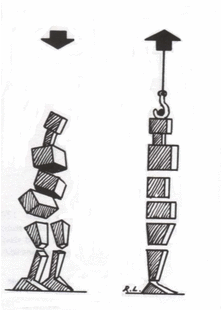
This line passes through the front of the spine and through the soft tissue, organizing the body so that its segments stack naturally. When this happens, gravity can travel through the body rather than pulling it apart.
The result is greater ease, efficiency, and structural balance.
People searching for Rolfing in Boston are often looking for this very experience: a body that feels aligned, supported, and integrated.
However, the real question is:
How do we actually accomplish this?
That question opens the door to the deeper craft of structural work using the original Rolf Method developed by Ida Rolf.
Becoming the Mechanic: The Wheel Analogy
One way to understand this process is to imagine the work of a bicycle mechanic truing a wheel.
When a mechanic adjusts the spokes of a wheel so it spins straight, something interesting happens:
A wheel can never be perfectly straight.
Instead, the straightness of the wheel is an approximation created by the sum of all the spokes working together.
The mechanic must resist obsessing over a single spoke.
Instead, they maintain a bird’s-eye view of the entire wheel.
Often, the mechanic will:
Spin the wheel
Squint slightly
Blur their vision on purpose
This helps them see the estimated line emerging from the movement of the whole system.
If they tighten one spoke too much, the entire wheel shifts out of balance.
The Human Body Works the Same Way
Working with the human body through myofascial release in Boston follows a similar principle.
The fascia — the connective tissue network that shapes the body — behaves like those spokes.
When we change tension in one place:
A shoulder adjusts
A rib cage reorganizes
The pelvis shifts
The entire structure relates differently to gravity
Changing one segment changes the whole system.
So the practitioner must constantly revise their perception of how the body relates to the line of gravity, moment by moment.
This is where the art begins.
Different Ways Practitioners Perceive the Line
Every practitioner develops their own way of perceiving the body’s relationship to this organizing line.
For example:
Ida Rolf herself relied strongly on visual perception.
She watched how the myofascial planes expanded and shifted, pushing body segments in new directions that better approximated the vertical line.
Other practitioners focus on function and movement, observing how the segments of the body coordinate to produce an upward thrust through the tissues that counteracts gravity.
Still others in modern structural and somatic therapy in Boston may explore more subtle perceptual frameworks, such as:
cranial wave dynamics
primary respiration
biodynamic movement within the tissues
Each approach offers valuable insight.
But the core message of Ida Rolf’s work remains grounded:
Whatever line you perceive must ultimately be related back into the physical tissue.
The Personal Journey of the Practitioner
Learning this skill is deeply personal.
Every practitioner working in:
structural integration
myofascial release in Boston
somatic therapy in Boston
or the broader world of Rolfing-inspired work
must eventually answer several questions for themselves:
How do I perceive the line in another human body?
How do I relate my perception to the client’s structure?
How do I coax the fascia to reorganize toward that line?
These questions are not answered through theory alone.
They are answered through touch, perception, and experience.
The Somatic Dimension
In somatic therapy in Boston, the idea of the line can even take on a psychological or emotional dimension.
Here the line may represent a landscape of emotional charges or internal tensions.
As different segments of the body reorganize around a clearer internal axis, people often report:
greater emotional clarity
reduced internal tension
a deeper sense of coherence in their bodies
Structure and experience are deeply intertwined.
The Original Rolf Method
While many people search online for Rolfing in Boston, the work practiced here follows the original Rolf Method developed by Ida Rolf, the foundational approach that preceded the later system known as Rolfing.
The focus remains on:
structural balance
fascial organization
gravity alignment
and the lived experience of embodiment
Using careful myofascial release and somatic awareness, the aim is not to impose a structure on the body, but to help the body discover a more efficient relationship to gravity.
Next: The Floating Sphere
The line is only one of the fascinating ideas that emerged from Ida Rolf’s work.
In the next article, we’ll explore another concept that expands the conversation even further:
the idea of the “floating sphere.”
It is a powerful way to think about balance, movement, and the body’s relationship to space.
Stay tuned.To make an appointment with Joel Gheiler, Certified Guild Rolf Practitioner, Click Here