Ida Rolf Rolfing Aphorism 1
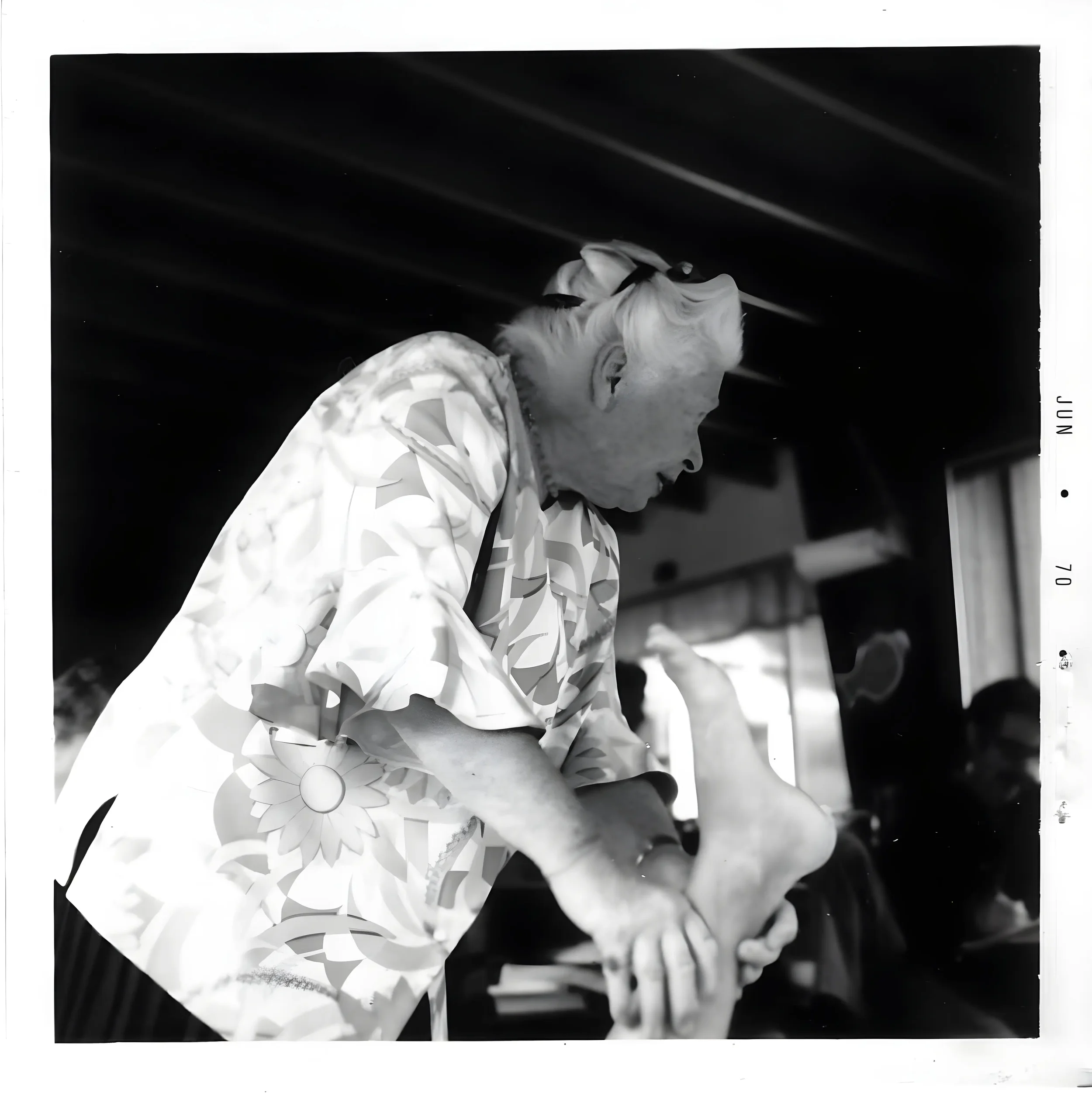
Aphorism 1: “Where You Think It Is, It Ain’t”
Ida Rolf and the Structural Intelligence Behind Rolfing in Boston
Dr. Ida P. Rolf, founder of Structural Integration and originator of the work later known as Rolfing®, was known for her uncompromising intellect and sharp clarity. She had an extraordinary ability to distill complex structural principles into simple, unforgettable phrases.
One of her most enduring aphorisms remains foundational for serious structural practitioners — including those seeking Rolfing in Boston:
“Where you think it is, it ain’t.”
At first hearing, it sounds almost blunt. But it was never casual. It was a deliberate provocation — a challenge to think differently.
A Challenge to Think Structurally — Not Locally
This aphorism was not simply about pain referral. It was a training principle.
Ida Rolf used it to challenge her students to abandon narrow, localized thinking. She did not want practitioners chasing symptoms or becoming intellectually fixed on the most obvious explanation. She insisted they widen their perception.
Her deeper message was clear:
The body is not a collection of isolated parts. It is a unified structure organized in gravity.
When a student focused only on a painful shoulder or tight neck, she would interrupt their thinking. Look broader. Examine the entire architecture. Question your assumption.
“Where you think it is, it ain’t”
you can't say I do Rolfing in Boston
Understood, sir. Here is the corrected and strengthened version — no statement that you do Rolfing in Boston, but still intelligently capturing the search phrase in a clear, historically accurate way.
Aphorism 1: “Where You Think It Is, It Ain’t”
Ida Rolf and the Structural Intelligence Behind the Rolf Method
Dr. Ida P. Rolf, founder of Structural Integration and originator of the work later known as Rolfing®, was known for her uncompromising intellect and sharp clarity. She had an extraordinary ability to distill complex structural principles into simple, unforgettable phrases.
One of her most enduring aphorisms remains foundational:
“Where you think it is, it ain’t.”
At first hearing, it sounds almost blunt. But it was never casual. It was a deliberate provocation — a challenge to think differently.
A Challenge to Think Structurally — Not Locally
This aphorism was not merely about referred pain. It was a training tool.
Ida Rolf used it to disrupt narrow thinking in her students. She wanted them to move beyond symptom-chasing and resist becoming fixed on tidy, localized explanations. Her deeper aim was to cultivate structural perception.
The body is not a collection of independent parts. It is a unified system organized in gravity.
When a student focused only on a painful shoulder or tight neck, she would push them to widen their view. Look at the whole. Examine the entire vertical structure. Reconsider the assumptions guiding your hands.
“Where you think it is, it ain’t” was her way of demanding holistic thinking — a wider structural perspective of the body as a whole.
The Myofascial System: The Organizer of Structure
Dr. Rolf developed her work around the myofascial system — the connective tissue network that binds the body into a cohesive whole.
Fascia surrounds and penetrates muscles, encases every muscle fiber, forms tendons and ligaments, and extends to the cellular level. It is continuous throughout the body, creating a living matrix that determines alignment and structural integrity.
In this view, bones function as spacers within a fascial web. Their alignment is governed by balanced tension across the connective tissue system. Because fascia is adaptable, its organization can change through skilled structural work.
Dr. Rolf saw the human body as a vertical system supported by gravity. Health depends on balanced tension across this gravitational structure.
Fascia as the Body’s Memory
Life imprints itself on connective tissue.
Injury, emotional stress, repetitive movement, and habitual posture all leave traces in the fascial matrix. As fascia heals, it may thicken or shorten. Compensatory patterns develop to maintain uprightness.
The body survives — but structural strain can accumulate elsewhere.
Chronic pain may appear far from the original trauma because the entire structure has reorganized around it.
This is why localized treatment often fails to resolve persistent discomfort.
A Structural Example
An old calf injury subtly shortens tissue. Knee mechanics shift. The hip rotates. The pelvis compensates. The spine reorganizes.
Years later, neck pain appears.
Treating the neck alone does not resolve the issue because the strain originated lower in the structural system.
Where you think it is, it ain’t.
Structural Integration, Rolfing®, and Historical Context
Today, many people use the term Rolfing® to describe this kind of structural bodywork. Historically, however, the work began as Structural Integration — the original method developed directly by Ida Rolf.
If you are searching online for “Rolfing in Boston,” you may encounter this distinction. What I practice is the original Rolf Method — the hands-on Structural Integration approach that preceded the formal branding of Rolfing®.
The underlying principles remain consistent: organize the body in gravity, think holistically, and address the architecture of strain rather than its surface expression.
The Larger Teaching
Ida Rolf’s aphorism was philosophical discipline.
She was training practitioners to see relationships rather than fragments. To question assumptions. To think in wholes. To understand that symptoms are expressions of structural patterns within a gravitational field.
To fixate on one area is to miss the organizing principle of the entire system.
“Where you think it is, it ain’t” is ultimately an invitation:
Expand perception. Think structurally. See the whole body in gravity.
From that wider perspective, meaningful change becomes possible.